If you’ve spent time with flashcard apps, you’ve probably heard of spaced repetition. Review a card at increasing intervals over time, and it sticks in your long-term memory with less effort than cramming. The science is solid.
But not all spaced repetition is equal. The algorithm underneath matters a lot, and most apps, including the default Anki setup, are still running on a 35-year-old algorithm that was designed before anyone had the data to do better.
Language Den uses FSRS. Here’s what that means, why it matters, and how it changes the way your vocabulary reviews actually work.
The old algorithm: SM-2
Anki popularised spaced repetition in the language-learning world, and for years its default algorithm was SM-2, developed by Piotr Wozniak in 1987. SM-2 was a genuine breakthrough. It took the theory of spaced repetition and turned it into something a computer could actually run.
The basic idea: every card has an “ease factor” that controls how quickly the interval grows. Rate a card Good and the interval multiplies by your ease factor (default 2.5, so 1 day becomes 2.5 days, then ~6 days, then ~16 days). Rate it Hard and the ease factor drops. Rate it Easy and it grows.
It worked. But it had some well-known problems.
Ease hell. If you rate a card Hard a few times in a row, your ease factor tanks. Once it’s low, it’s very hard to recover. Cards end up with short intervals forever, even after you’ve clearly learned the word. Anki users have been complaining about this for years.
Fixed forgetting target. SM-2 doesn’t have an explicit model of memory. It approximates scheduling without actually predicting when you’ll forget. There’s no feedback loop between your real recall rates and the algorithm’s predictions.
No personalisation. SM-2 uses the same scheduling logic for everyone. Your forgetting curve is your forgetting curve. SM-2 doesn’t know that, and doesn’t try to learn it.
The new algorithm: FSRS
FSRS (Free Spaced Repetition Scheduler) was developed by Jarrett Ye and published in 2022. It was built on a much larger dataset of real reviews, incorporates modern memory research, and addresses most of SM-2’s structural problems.
The core difference: FSRS is actually modelling your memory, not approximating it.
It tracks two values for every card you study:
Stability — how long you can go before you have roughly a 90% chance of still remembering the word. A stability of 10 means you’d probably recall it 10 days from now. A stability of 200 means you’d probably recall it in about six months.
Difficulty — how hard this particular card is for you, on a scale from 1 to 10. It starts as an estimate and updates over time based on your actual responses.
Every time you review a card, FSRS uses these two values to calculate a retrievability score: the probability you’d remember this word right now. When retrievability drops to around 90%, it’s time for a review. That’s when the card surfaces.
The result is a tighter feedback loop than SM-2. Rather than adjusting an abstract ease factor, FSRS is directly modelling your memory and scheduling reviews at the mathematically optimal moment.
How your ratings change the algorithm
When you finish a review in Language Den, you tap one of four buttons. Here’s what each one actually does.
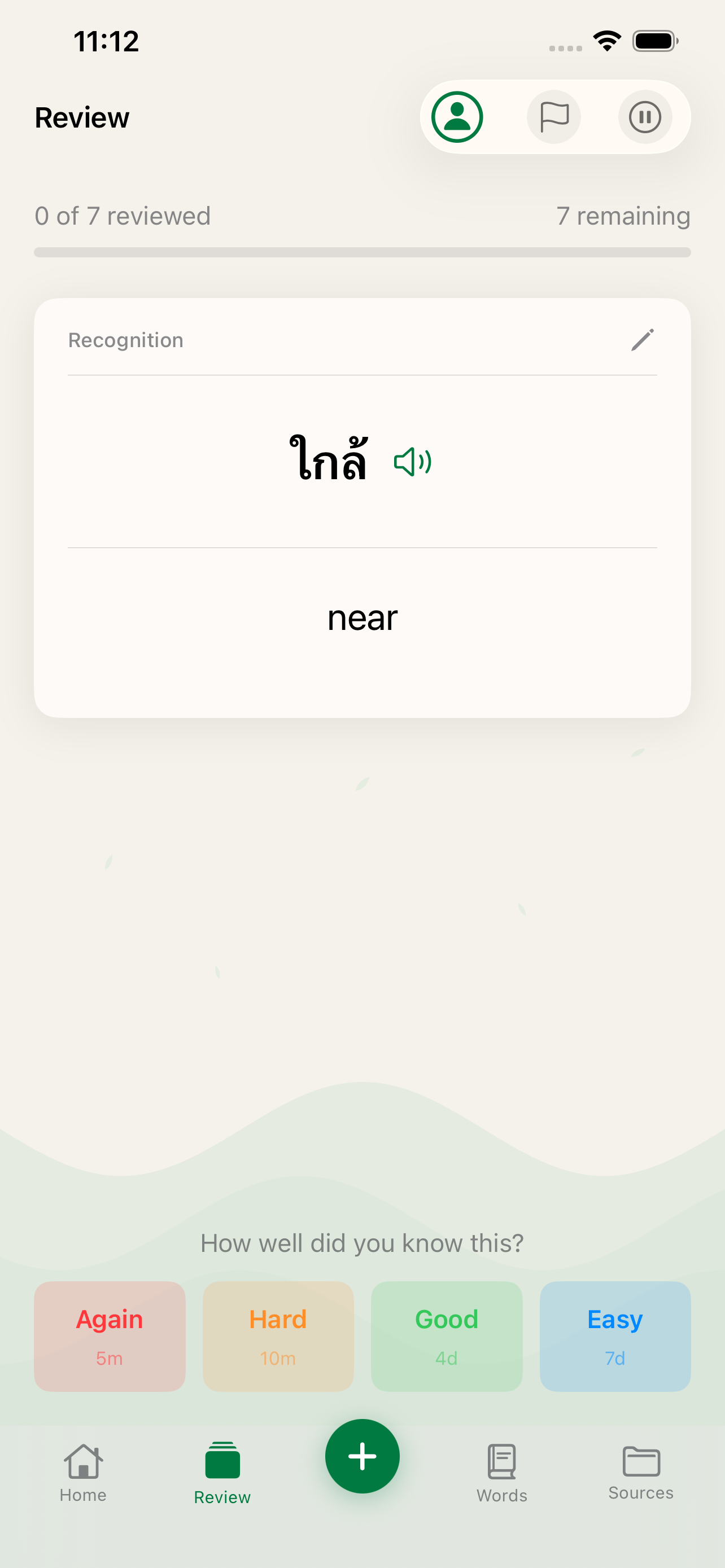
Again — You couldn’t recall it. FSRS marks this as a lapse. Your stability resets to a small number (you’ll see this card again in a day or two), and difficulty nudges up slightly. The algorithm isn’t punishing you: it’s making sure you see the card again while your partial memory is still warm.
Hard — You got it, but only barely. Stability increases less than a smooth recall would produce, and difficulty bumps up a little. Your next review comes sooner than if you’d tapped Good.
Good — Normal recall, comfortable effort. This is the expected response for a well-scheduled card. Stability increases significantly. How much depends on the card’s current difficulty: an easy card might jump from a 10-day interval to 30 days. A harder card might go from 10 days to 18.
Easy — You barely had to think. Stability gets a bigger boost, and difficulty decreases. Tap Easy consistently and you’ll see a card infrequently, because the algorithm now knows it requires little effort to maintain.
A concrete example: suppose you’ve been learning the Spanish word imprescindible (indispensable). You rated it Good on its last three reviews. Its stability is now around 30 days. You review it today, tap Good again. FSRS might push the next review out to 90 days. If you tapped Easy, it might go to 150 days.
Now suppose you tap Hard instead. The interval might grow to only 50 days, and difficulty ticks up. If you tap Hard again next time, difficulty creeps higher still, and your intervals will grow more slowly until you’ve clearly mastered the word.
Why FSRS outperforms SM-2 in practice
Independent benchmarks, including testing done by the Anki community when FSRS was first released as a plugin, showed FSRS achieving better retention rates with fewer reviews. The typical finding: around 20-30% fewer reviews for the same retention target.
For vocabulary learning, that gap matters. If you’re maintaining a deck of 1,000 words, the difference between 50 daily reviews and 35 is real time you can spend learning new words rather than over-reviewing ones you already know.
The structural improvements that drive this:
No ease hell. FSRS doesn’t have an ease factor that spirals downward and gets stuck. Difficulty updates smoothly based on your actual performance, and it recovers when you start recalling things easily.
Personalised forgetting curve. FSRS learns your memory patterns over time. If you consistently retain words longer than the default model predicts, your intervals will stretch accordingly. Two people learning the same 1,000 words in Language Den might have very different review schedules, because they forget at different rates.
Explicit retrievability target. Language Den uses a 90% target retrievability. This means your reviews are always timed so that, statistically, you have a 90% chance of remembering each word when it surfaces. You can think of it as the algorithm keeping all your vocabulary just above the forgetting threshold at all times.
What this looks like in Language Den
When you add a word to Language Den, FSRS immediately starts scheduling it. The first review is designed to catch the word while your initial memory is fresh, typically within a day or two.
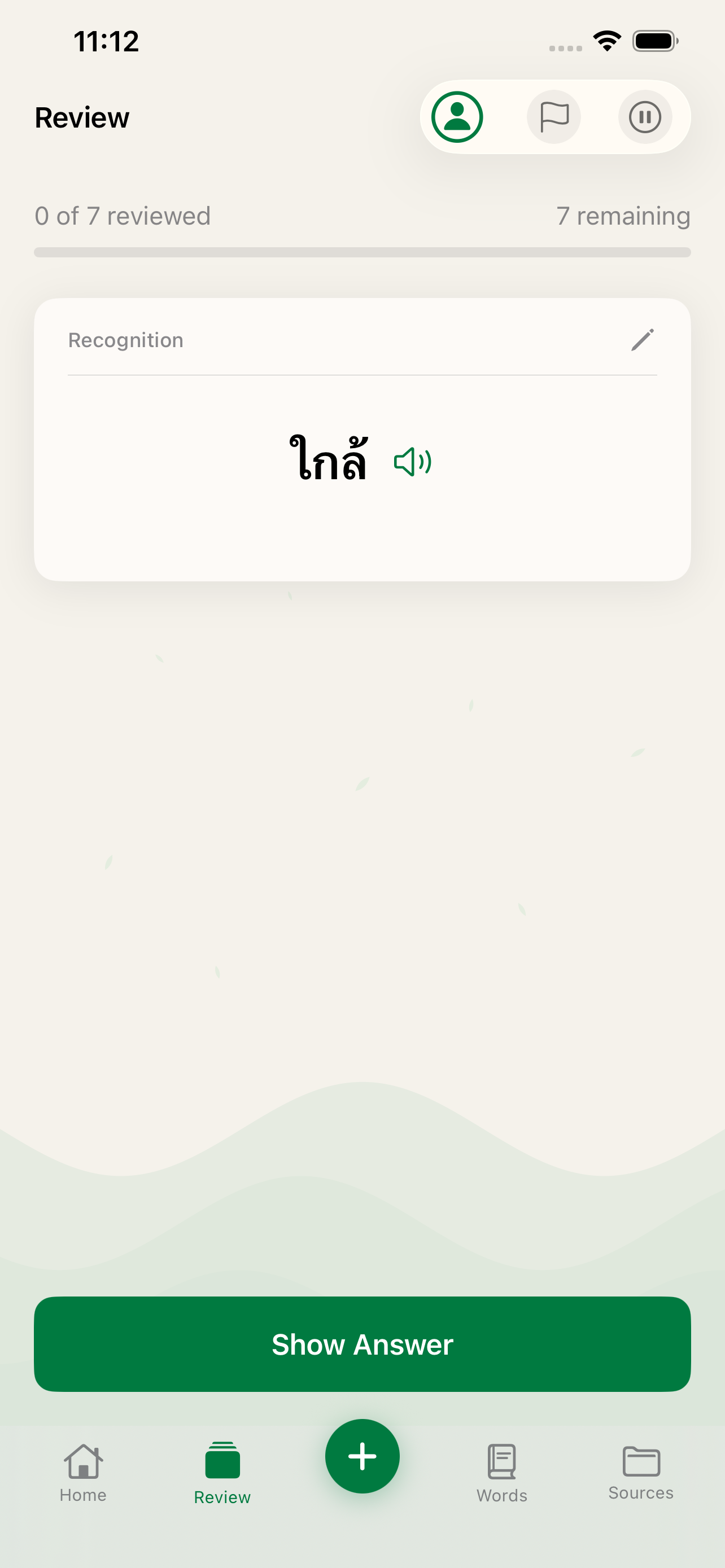
As you build your review history, FSRS gets a better read on your memory patterns. Early on, the intervals are conservative. Over time, as the algorithm gathers more data points, it gains confidence in its predictions and your intervals can grow longer.
You never have to think about any of this. You add words, you tap review, you rate how well you recalled each one. Language Den handles the scheduling.
But the reason it works, the reason your vocabulary actually sticks instead of fading after a week, is that the algorithm underneath is genuinely trying to model your memory. Not approximating it. Not using the same schedule for everyone. Actually building a model of how you forget, and scheduling your reviews accordingly.
That’s what FSRS is. And it’s why we built Language Den around it.
Ready to try it? Download Language Den on the App Store and start building vocabulary with the most effective spaced repetition available.