Most vocabulary apps give you a list. Words go in, words come out during review sessions, and the list grows. It works, up to a point.
What gets lost is context. You add “곱창” to your Korean deck. Three months later it comes up in a review and you vaguely remember it has something to do with food. But you’ve completely forgotten where you first encountered it — the restaurant scene in that drama, the one where the main characters have an argument over a meal. That memory would have helped. The word was funnier in that context. It would have stuck better.
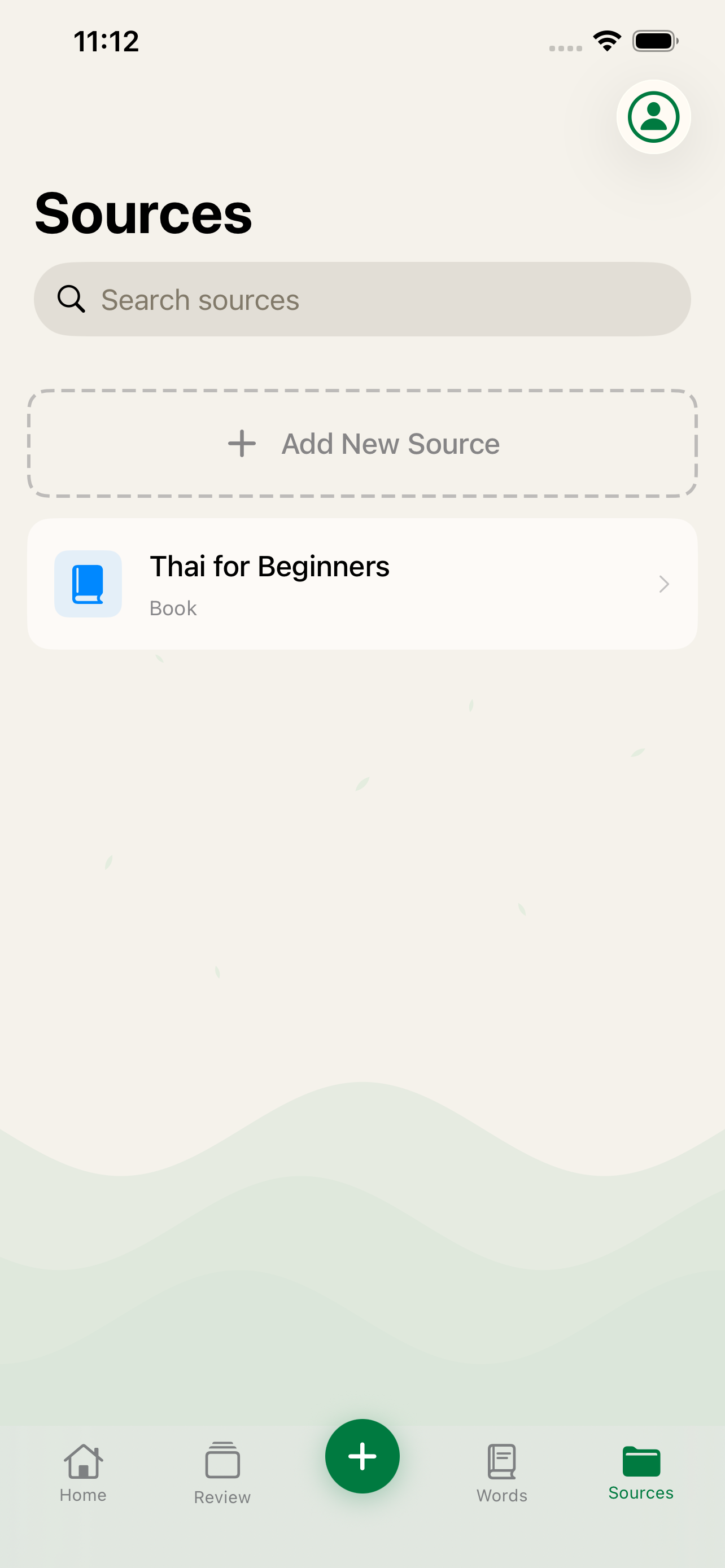
Language Den has a feature for this: Sources.
What Sources are
A Source in Language Den is a container for vocabulary from a specific place. You create a Source, give it a name, choose a type, and then add words to it.
The types cover the most common places people encounter new vocabulary:
- Book
- TV Series
- Podcast
- Newspaper
- Article
- Other
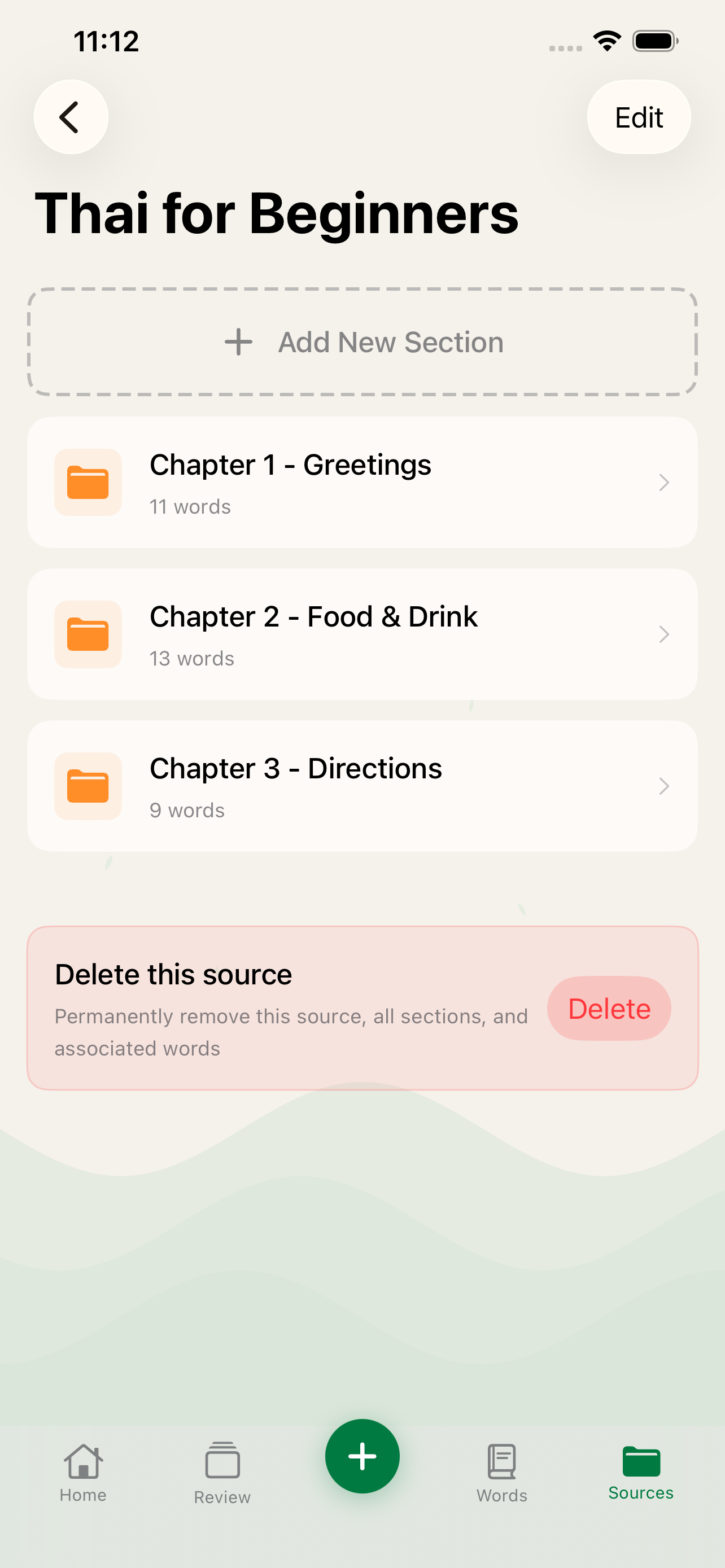
Within each Source, you can create sections. A book might have chapters. A TV series might have episodes or seasons. A podcast might have individual episodes worth separating out. Words live inside sections, which live inside Sources.
Why this changes how vocabulary sticks
There’s a well-documented phenomenon in memory research called the encoding specificity principle: memories are easier to retrieve when the context at retrieval matches the context at encoding. In plain language, where and how you learned something affects how well you remember it later.
A word you learned in isolation — added to a generic list — has one memory hook: the word itself. A word you learned from the third episode of a show you love has multiple hooks: the scene, the characters, the emotional tone, the moment you stopped to look it up. Those hooks reinforce each other.
Organising vocabulary by Source doesn’t add those hooks — you made them when you encountered the word. But it does preserve the connection between the word and its origin. When you see a word from “Squid Game Season 1, Episode 3” come up in a review, you’re being reminded of where it came from, which activates the memory of that context.
The workflow in practice
The Sources workflow slots naturally into how people consume content when learning a language.
Say you’re working through a Thai novel. You create a Source named after the book and a section for each chapter. When you encounter a word you don’t know, you add it to the current chapter’s section. Words accumulate alongside your reading progress, anchored to the part of the book where you found them.
The same works for shows and podcasts. Create the Source once, add sections as you go, and add words in the moment you encounter them — or later via Quick Notes if you don’t want to break your flow.
By the time you’ve finished a series or a book, you have a vocabulary set that maps directly to your experience of that content. Reviewing those words feels connected to something real, not abstract.
Reviewing by Source
Sources also give you a way to focus your review sessions. If you’ve been watching a specific show and want to solidify the vocabulary from it, you can review just those words — the content you’re most likely to hear again in the next episode.
This is different from reviewing your entire deck at random. It creates a tighter feedback loop between what you’re consuming and what you’re studying, which tends to accelerate both comprehension and retention.
Starting out
If you’re just getting started with Language Den, you don’t need to build an elaborate Source structure from day one. The simplest version is to create one Source for whatever you’re currently consuming — a show you’re watching, a book you’re reading — and add words to it as they come up.
Over time you’ll accumulate a vocabulary history that maps to your actual learning journey. Each Source becomes a record of where you’ve been and what you learned there.
Sources in Language Den support Books, TV Series, Podcasts, Newspapers, Articles, and a general Other category. Words added to a Source can be organised into sections and reviewed independently from your main deck.